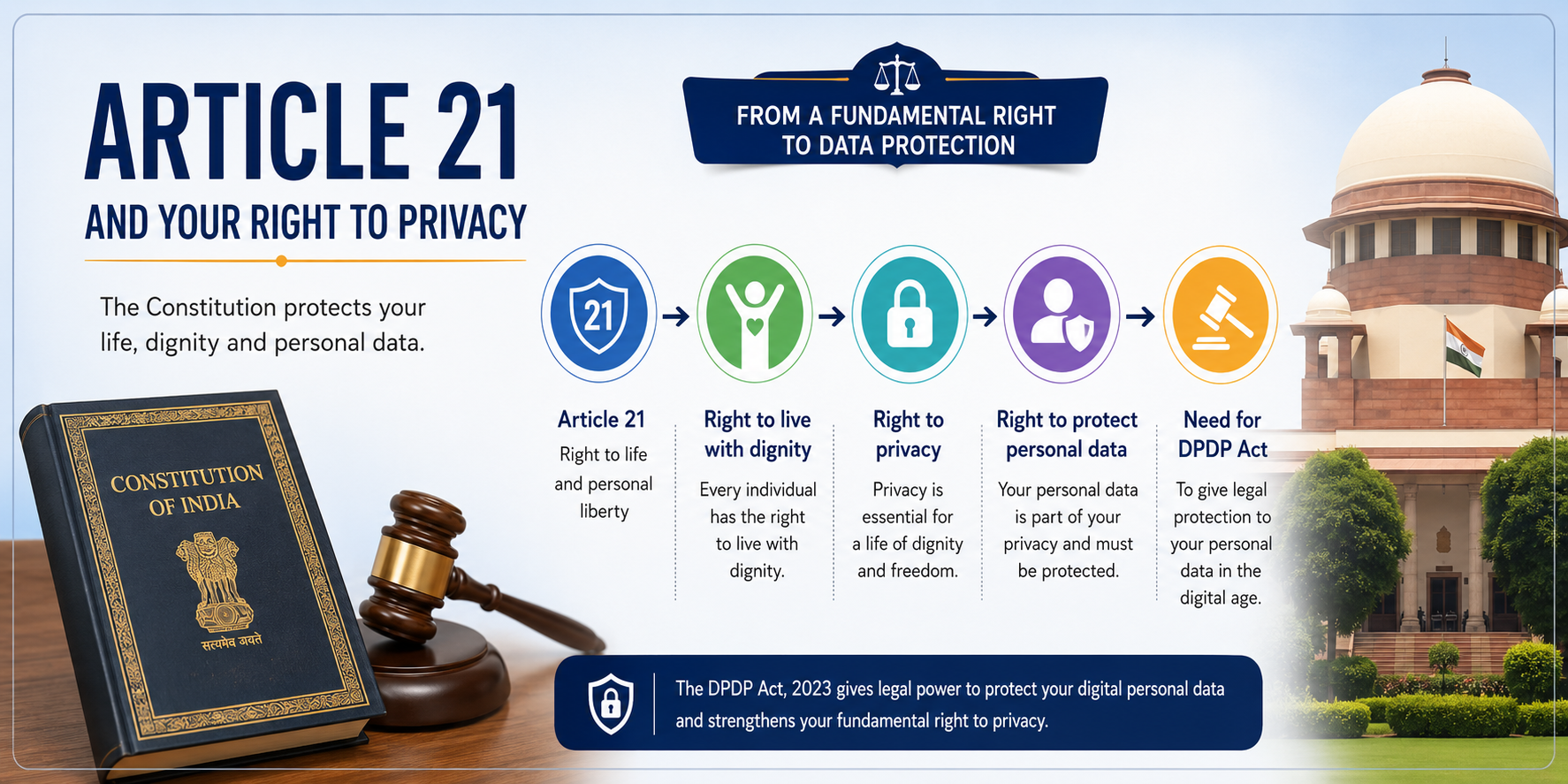
Think of Article 21 as a constitutional safety shield for every person in India.
Article 21 says, “No person shall be deprived of his life or personal liberty except according to procedure established by law.” In simple words, the government cannot interfere with your life or freedom unless there is a valid law and fair procedure.
Now, earlier people thought Article 21 mainly meant physical life and freedom. But over time, the Supreme Court said that life and liberty also include dignity, choice, autonomy, and privacy. In the K.S. Puttaswamy v. Union of India judgment, a 9-judge bench of the Supreme Court clearly held that privacy is a fundamental right under the Constitution of India.
What does privacy mean in data protection?
As a layman, understand it like this:
Your mobile number, Aadhaar number, address, bank details, photos, health records, location, email ID, browsing habits, biometric details, etc. are part of your personal life.
So, when an app, college, company, bank, hospital, or government portal collects your data, it is not just “information.” It is connected to your identity, dignity, safety, and freedom.
That is why data protection is linked to Article 21.
Example
Suppose you give your mobile number to a shopping app only for delivery. Later, the company sells your number to marketing agencies without informing you. You start receiving spam calls, loan offers, fraud messages, and unwanted promotions.
This affects your privacy.
Article 21 says that your privacy is part of your personal liberty. So your data should not be misused casually.
How DPDP Act is connected to Article 21
Article 21 gives the constitutional foundation:
“Your privacy is your fundamental right.”
The Digital Personal Data Protection Act, 2023 gives the practical rules:
“How companies, apps, institutions and organisations should collect, use, store and delete your digital personal data.”
The DPDP Act recognises both sides: individuals have a right to protect their personal data, and organisations may process data for lawful purposes.
Easy way to remember
Article 21 = Your right to privacy.
Puttaswamy judgment = Supreme Court confirmed privacy as a fundamental right.
DPDP Act = Law that tells organisations how to handle your digital personal data.
Conclusion
Article 21 protects your right to live with dignity and personal freedom, and the Supreme Court has said that this includes your right to privacy; therefore, your personal data cannot be collected, used, or shared unfairly, which is why India created the DPDP Act.
Prepared and shared for academic reading by:
Dr. Arpana Chaturvedi
Associate Professor & HOD – IT & Data Analytics
New Delhi Institute of Management